What the Glasshouse Teaches: Rarity, Patience, and the Irreducible Standards of Exceptional Companionship
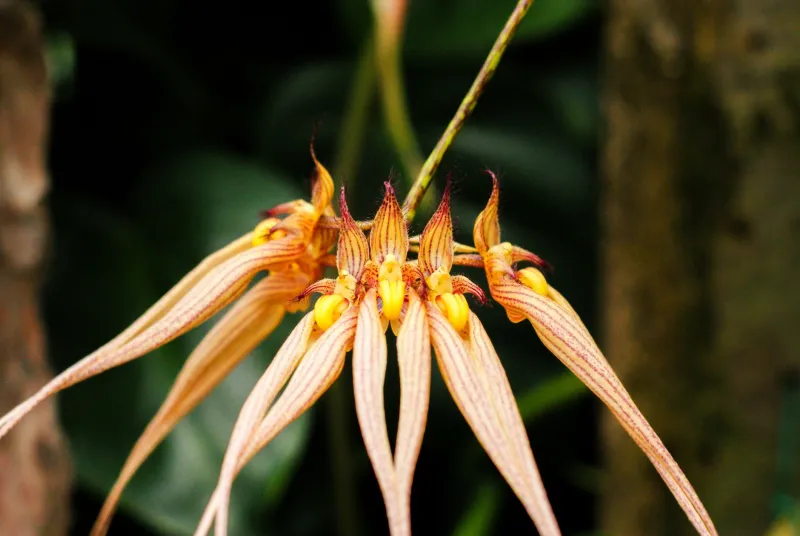
The Glasshouse and the Standard It Keeps
There is a particular quality of light inside a well-maintained glasshouse—diffuse, considered, neither too harsh nor too dim. The serious cultivator adjusts ventilation, monitors humidity, and calibrates temperature not by approximation but by long-accumulated knowledge. The orchid, more than almost any other flowering plant, demands precisely this kind of sustained, intelligent attention. It does not reward shortcuts. It does not respond well to rushed decisions. And it will not, under any circumstances, bloom on someone else's schedule.
Those who tend orchids professionally speak of the discipline in terms that sound almost philosophical: knowing when to intervene and when to stand back, recognising the difference between a plant that is resting and one that is failing, understanding that the absence of visible progress is not the same as stagnation. It is, in short, a practice of discernment—and discernment, as any genuinely cultivated person understands, is not a quality that can be hurried into existence.
This, it turns out, has a great deal to say about companionship of the highest order.
Why Scarcity Is Not a Flaw but a Feature
In an age that prizes velocity and volume—same-day delivery, instant gratification, the frictionless transaction—rarity has become genuinely countercultural. The assumption that more choice and faster access constitute an improvement is so pervasive that it takes a conscious act of will to question it. Yet the most discerning individuals in London's private and professional circles have not abandoned this questioning. They understand, from experience, that the things worth having are almost always the things that require something of you first.
The Phalaenopsis, prized in cultivation for its architectural elegance, takes months to produce a single flowering stem. The Paphiopedilum, known colloquially as the slipper orchid, may spend years in vegetative growth before offering its first bloom. A collector who understands this does not find it frustrating. They find it clarifying. The wait is not incidental to the value—it is constitutive of it. What is freely and instantly available to everyone carries, almost by definition, a different weight than what demands patience, knowledge, and a willingness to engage on terms set by the thing itself rather than by the convenience of the seeker.
The same principle governs truly exceptional companionship. The companion who can engage fluently across the registers of a formal dinner, a private gallery viewing, or a quiet evening of genuine conversation is not a product that can be assembled quickly or replicated efficiently. She is, in the truest sense, cultivated—through years of intellectual engagement, social observation, and the kind of careful self-development that no amount of urgency can compress.
The Cost of Mistaking Availability for Quality
London offers, to those with means, an extraordinary range of experiences. The city's hospitality, cultural life, and private social world are among the most sophisticated on earth. Yet the sheer abundance of options creates its own hazard: the temptation to conflate accessibility with excellence. A restaurant that can seat you tonight is not necessarily the one worth eating at. A connection that requires no particular effort to establish is not necessarily the one worth sustaining.
The gentleman who has spent any time in Belgravia's more considered social circles will recognise this distinction instinctively. There is a reason that the most valued introductions in this world come through trusted intermediaries rather than open directories. There is a reason that the finest tailors on Savile Row maintain waiting lists rather than clearing them. Quality, in any domain, has its own pace—and the attempt to override that pace invariably produces something that resembles the real thing without possessing its essential character.
This is not snobbery. It is a straightforward observation about how certain forms of excellence are structured. They are not withholding themselves arbitrarily; they are simply incapable of existing at a different speed without ceasing to be what they are.
Selectivity as Mutual Respect
One of the less-discussed aspects of truly distinguished companionship is the degree to which selectivity operates in both directions. The companion of genuine quality is not indiscriminate in her engagements—and this is not a commercial posture but a reflection of how meaningful connection actually functions. A conversation that matters requires two people capable of sustaining it. An evening of real distinction requires a shared investment in making it so.
The orchid grower who accepts every cutting offered to them, tends every variety without regard to their specific requirements, and attempts to bring every plant to flower simultaneously will produce, at best, a crowded and mediocre collection. The cultivator who selects carefully, tends specifically, and allows each specimen the conditions it actually needs will produce something genuinely worth seeing.
Selectivity, understood this way, is not exclusion for its own sake. It is the precondition for quality. And it implies, importantly, a reciprocal standard: those who seek truly exceptional companionship are themselves expected to bring something to the encounter—curiosity, courtesy, an appreciation for what is being offered, and the patience to allow a connection to develop at its own natural pace rather than forcing it into a predetermined shape.
The Long View and Why It Matters
The most accomplished orchid cultivators are not people who think in seasons. They think in years. They understand that the most beautiful specimens are almost always the oldest, the most carefully tended, the ones that have been given time to develop the particular character that only time can produce. There is no accelerated path to a twenty-year-old Cymbidium that has been brought through decades of careful cultivation. You cannot purchase its equivalent from a garden centre, however well-stocked.
The implication for those who seek companionship of lasting distinction is straightforward: the investment of patience and discernment is not a luxury but a necessity. The encounter that is arranged carelessly, pursued impatiently, or treated as a transaction rather than an exchange will produce, at best, a pale imitation of what is actually possible. The encounter approached with genuine attention—with respect for the conditions under which something rare can actually flourish—produces something of an entirely different order.
Belgravia Orchids takes its name from this understanding. The orchid is not an accident of beauty. It is the product of exacting conditions, sustained care, and an unwillingness to compromise on what is required for genuine excellence. The companionship this house offers is cultivated in precisely the same spirit—selected with care, developed with patience, and presented only when the conditions are genuinely right.
Some things, as the glasshouse teaches, simply cannot be rushed. And those who understand this are the ones who ultimately encounter something worth the wait.