Conversational Alchemy: Transforming London's Grandest Rooms into Spaces of Genuine Connection
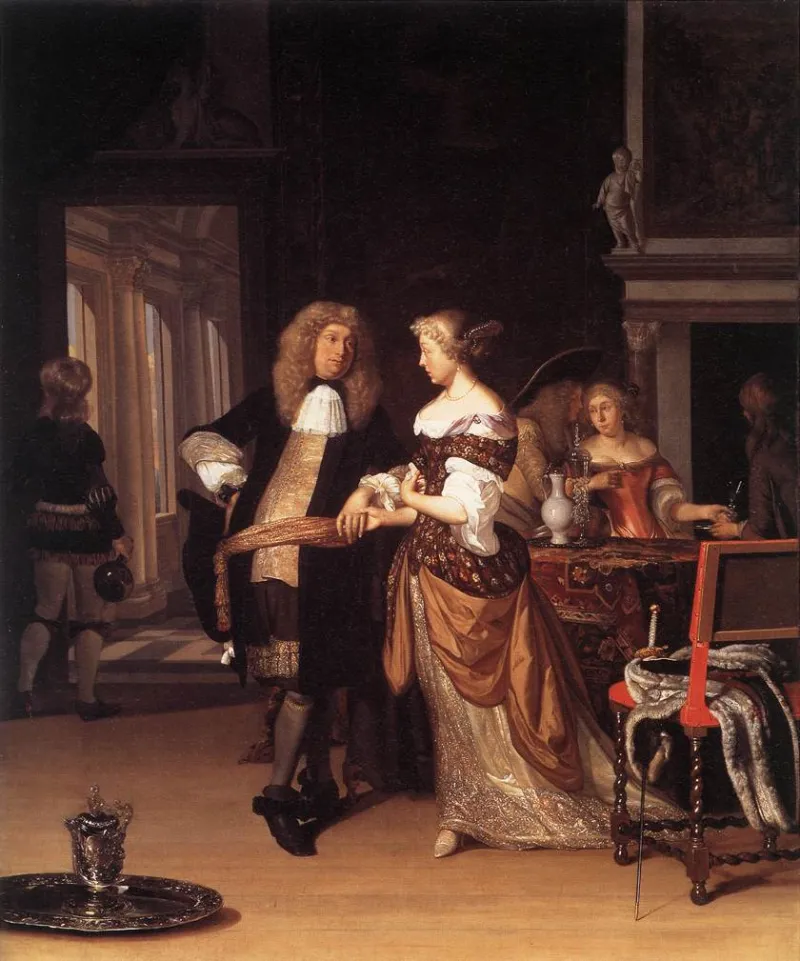
Photo: Eglon van der Neer, Public domain, via Wikimedia Commons
There is a particular kind of evening that London's most discerning gentlemen know well — one that begins in the familiar surroundings of a private members' club, moves through a candlelit dinner in Mayfair, and concludes somewhere quieter, with the sensation that something genuinely meaningful has passed between two people. Such evenings are not engineered by circumstance. They are built, deliberately and with considerable skill, through the practice of meaningful conversation.
At Belgravia Orchids, we have long understood that intellectual and emotional engagement is not an embellishment to refined companionship — it is its very foundation. The companions we celebrate are not merely adept at navigating London's social calendar; they are practitioners of a conversational craft that transforms even the most formal gathering into an occasion of authentic warmth.
The Poverty of Pleasantries
London's social landscape can be, for all its splendour, surprisingly resistant to depth. The seasonal rhythm of Ascot, the Chelsea Flower Show, charity galas in Kensington — these events are governed by a certain conversational currency: observations about the weather, remarks about the room, carefully neutral commentary on mutual acquaintances. Such exchanges serve their function. They smooth the surface of social interaction and signal belonging.
But they are, in the end, a kind of poverty. The gentleman who has spent an evening surrounded by witty small talk often departs feeling curiously hollow — as though he has consumed a meal of considerable presentation but little nourishment. The most distinguished companionship recognises this hunger and answers it with something more substantial.
The shift from pleasantry to genuine dialogue requires a particular courage — the willingness to ask a question that actually matters, to offer an opinion that carries some weight, to resist the gravitational pull of the safely banal.
The Architecture of a Thoughtful Question
If there is a single skill that separates accomplished conversationalists from merely agreeable ones, it is the art of the well-placed question. Not the interrogative thrust of an interview, nor the performative curiosity of someone gathering ammunition for their next anecdote — but the genuine, unhurried question that invites a person to articulate something they have not quite said aloud before.
Consider the difference between asking a companion what they do for work, and asking what aspect of their work they find most unexpectedly absorbing. The first invites a rehearsed response. The second opens a door. The most refined companions understand this architecture instinctively. They know that the best questions are not the cleverest ones, but the most considered — those that demonstrate careful attention to what has already been said.
In settings such as the drawing rooms of private members' clubs along Pall Mall, or across the table at a Belgravia dinner party, this quality of attention is immediately perceptible. It creates a particular kind of ease — the ease of feeling genuinely heard — that no amount of social polish can replicate.
Memory as an Act of Regard
There is a form of intimacy that has nothing to do with proximity, and everything to do with remembrance. When a companion recalls, without prompting, that you mentioned your daughter's piano recital three weeks prior, or that you expressed a preference for a particular Burgundy during a conversation in passing — the effect is quietly profound.
This is not mere technique. It is, at its root, an expression of regard. To remember what someone has told you is to signal that their words carried weight, that they were not simply filling silence but contributing something worth retaining. In a city as relentlessly forward-moving as London, where the pace of professional and social life can render even significant moments forgettable, this quality of attentive memory is genuinely rare.
The companions of distinction cultivate this faculty deliberately. They approach each engagement not as a discrete event but as a continuing conversation — one in which earlier chapters inform the present exchange and lend it the texture of genuine history.
Reading the Room, and the Person Within It
Meaningful conversation does not occur in a vacuum. It is shaped by context — by the formality of the setting, the mood of the evening, the unspoken dynamics of the room. An accomplished companion navigates these variables with the same attention a conductor brings to tempo: sensing when the moment calls for levity, when it invites seriousness, and when silence is, in fact, the most eloquent response available.
At a formal dinner in one of Belgravia's Georgian townhouses, the conversational register will differ considerably from a quieter supper at a neighbourhood restaurant in Chelsea. The ability to modulate — to be equally at ease discussing the geopolitical implications of a recent election and the relative merits of two rival cheesemakers at Borough Market — is a form of intellectual flexibility that cannot be feigned.
What it requires, above all, is genuine curiosity about the world and the people within it. The companion who approaches each evening with authentic interest in her surroundings and her companion will always outperform one who relies on a repertoire of prepared topics, however well-chosen.
Authenticity as the Final Refinement
Perhaps the most counterintuitive truth about meaningful conversation is that its ultimate sophistication lies not in wit, nor breadth of knowledge, nor even the quality of one's questions — but in authenticity. The willingness to be, occasionally, genuinely uncertain. To say that one does not know, but would very much like to understand. To allow a moment of real feeling to surface without immediately covering it with social composure.
This quality is, in London's more rarefied circles, surprisingly uncommon. The social training that produces polished, confident conversationalists also tends to produce a certain guardedness — a reluctance to be caught in any posture that might be read as vulnerability. The companion who can, with grace and without performance, set that guardedness aside creates something that lingers long after the evening has concluded.
At Belgravia Orchids, the companions we hold in highest regard are those who understand that true refinement is not the absence of feeling, but its most considered expression. An evening of genuine connection — one in which both parties depart feeling, however fleetingly, more fully known — is the highest form of companionship London's social landscape can offer. And it begins, always, with the courage to say something that actually means something.