The Eloquence of Stillness: Why the Most Refined Companions Know When Not to Speak
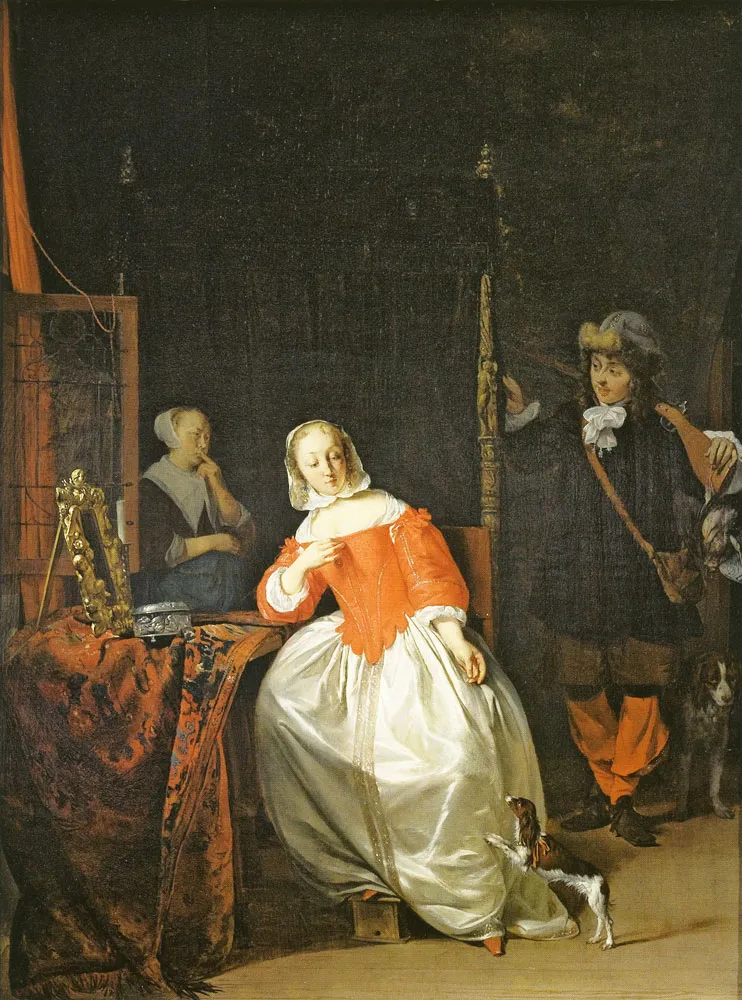
Photo: Gabriel Metsu, Public domain, via Wikimedia Commons
There is a particular kind of ease that settles over a room when two people are genuinely comfortable in one another's presence. It requires no performance, no filler, no carefully maintained stream of pleasantries. It is, quite simply, the ease of not needing to speak — and it is among the most telling measures of authentic sophistication.
In London's most elevated social environments, from the hushed dining rooms of Belgravia to the contemplative galleries of Mayfair, this quality is not merely appreciated. It is, for those who have experienced it, quietly indispensable.
The Tyranny of Continuous Conversation
Modern social life — even at its most polished — has developed an unfortunate relationship with silence. The instinct to fill every pause, to paper over every lull with commentary or anecdote, reflects a kind of anxiety that is fundamentally at odds with genuine refinement. It suggests that the company itself is insufficient to sustain the moment; that without the scaffolding of words, the connection would simply collapse.
For the high-net-worth gentleman navigating a demanding professional and social calendar, this constant performance of engagement can become quietly exhausting. The boardroom demands articulation. Client dinners require charm. Public appearances call for presence and wit. By the time a private evening arrives, the prospect of yet another obligation to converse — however pleasantly — can feel less like companionship and more like an extension of the working day.
A companion who understands this — who recognises that silence offered in the right spirit is a form of generosity — provides something that no amount of brilliant conversation can fully replicate.
What Comfortable Silence Actually Signals
Psychologists who study interpersonal connection have long noted that the willingness to sit quietly with another person is a reliable indicator of genuine intimacy. Unlike conversation, which can be managed, rehearsed, and performed, silence cannot easily be faked. When it is comfortable, it signals trust. When it is shared without self-consciousness, it suggests that neither party requires the other to be anything other than what they are.
In the context of refined companionship, this carries particular weight. A companion who fills silence reflexively — however charmingly — reveals, perhaps unwittingly, a degree of uncertainty about whether her presence alone is sufficient. The companion who can set down a glass of Burgundy, look out across a candlelit table, and simply be without reaching for conversation demonstrates a quality of confidence and attunement that is genuinely rare.
This is not passivity. It is, in fact, a form of active listening — an awareness of the other person's state that is responsive rather than reflexive.
The Architecture of a Quiet Evening
Consider the private dining experience at one of London's more discreet establishments — the kind of table tucked into a corner of a Georgian townhouse in SW1, where the service is unhurried and the menu changes with the season. The food is, of course, part of the occasion. But for the gentleman who has dined well many times, the lasting memory of such an evening is rarely the dish itself.
It is the quality of the company. And that quality is often defined less by what was said than by what was not.
A companion who understands the rhythm of such an evening — who knows when to engage and when to allow the moment to breathe — transforms a meal into something closer to an experience. She might offer an observation as the first course arrives, and then permit a comfortable silence to accompany the main. She might lean into a shared appreciation of something on the plate or in the room without immediately translating it into words. These small calibrations, seemingly minor in isolation, accumulate over the course of an evening into something that feels remarkably like ease.
The same principle applies at cultural events. A performance at the Royal Opera House is not improved by whispered commentary between acts. A private view at a Cork Street gallery does not require every painting to be discussed. Sometimes the most sophisticated response to beauty is simply to stand in it, together, without the need to annotate the experience.
The Cultivation of Stillness as a Social Art
It would be a mistake to suggest that comfortable silence is simply a natural gift — something one either possesses or does not. Like most social graces, it is cultivated. It requires a certain quality of self-possession: the ability to be present without performing presence, to feel settled in one's own company and therefore to offer that settledness to another.
Among Belgravia Orchids' most accomplished companions, this quality is understood not as an absence of social skill but as its fullest expression. The capacity to move fluidly between animated conversation and companionable quiet — to read a room, to read a person, to understand what the moment calls for — reflects an intelligence that goes well beyond social aptitude.
It is, in the truest sense, an art form.
Why Discerning Gentlemen Seek This Quality
The gentleman who has spent decades in the company of interesting, articulate, accomplished people eventually develops a refined sense of what he actually values in another's presence. The novelty of brilliant conversation retains its appeal, naturally. But alongside it — and sometimes surpassing it — grows an appreciation for the companion who does not require the evening to be a production.
This is not a preference for dullness. It is a preference for authenticity. For the quality of presence that makes a long drive through the English countryside in October feel like precisely the right way to spend an afternoon, even if barely a dozen words are exchanged. For the companion who can attend a concert at Wigmore Hall and understand, instinctively, that the hour afterwards is for reflection rather than review.
In the end, the companions who are remembered longest are rarely those who said the most memorable things. They are those in whose company a gentleman felt, without quite being able to explain it, entirely himself.
And that, in the lexicon of truly distinguished companionship, is the highest possible compliment.